Showing posts with label My Work and Projects. Show all posts

Apr 13, 2009

Groundswell Blook Report:Chapter Nine – Embracing the Groundswell

Groundswell is broken down into three parts. Part two (chapters 4-9) focus on tapping the groundswell. The authors provide advice and a strategic framework on how to do this.

Chapter 9: Embracing the groundswell

FriendFeed Room: Chapter Nine reference links and case studies from the book. Join the room and start a conversation.

Feature Video: Procter & Gamble VP Patrick Arlequeeuw talking about using innovation and embracing crowds to create the next $23B brand

This video is from September 2007 and it’s called “Blogging for Business”. This is a very interesting case study on how P&G is transforming itself from being a slow gigantic corporation to an innovative, responsive and collaborative organization.

What I learned:

1) If you reach a level where you can embrace your customers do it! You have willing participants who want to help you shape your company and your products and services.

2) Culture kills Groundswell initiatives and it will kill innovation. If you don’t encourage open communication, sharing and taking risk by putting your ideas “out there” then embracing is not for you.

3) That companies must have succession mechanisms in place in order to ensure their Groundswell program is sustainable. Your management team must be a “groundswell team” and champion all efforts. Don’t leave it to one person to champion. I’m starting to see that some of the companies case studied in the book haven’t continued with their Groundswell initiatives. Loblaws, Credit Mutael and Snausages are three examples in particular. This appears to be because the key Groundswell leader left.

4) Embrace people within your company as well as from the outside.

5) You will start to see interesting ideas evolve and natural cross collaboration begin to take place. People will start to connect the dots with ideas and thoughts that you’d never dreamed of seeing. This is where innovation really starts to come to life.

6) Make sure your online groundswell activities are tied to in real life ones. Case in point. I can rank Presidents Choice products online but when I go to their stores I don’t see any signage identifying their products as “Consumers Top Choice”. What I see instead is “Even Lower Prices”. What exactly is Loblaw positioning their Presidents Choice Product Line as?

Mar 23, 2009

Integration B2B marketing into your business

UPDATE: My B2B Marketing Integration Framework evolves. For an updated version please check out this post. Thx.

What I find is that many companies rush to market with new solutions, services, partners and divisions without spending the necessary time and resources to put their best foot forwards. Here is a phased approach model that may help you keep on course.

The end goal is to institutionalize b2b marketing into your organization. This can be a big challenge depending on company size, patience, culture etc.

Methodology,Mar2009

If your company has been adding partners on a whim, or adding solutions to a bloated offering watch out! In markets where you are selling complex solutions going to market “half cocked” is a big mistake. You’ll probably go nowhere. Why? Ask your sales rep! Ask your systems engineer! Both of them will tell you that they will not put their relationship and reputation on the line by introducing a new solution offering to an account if they don’t have the confidence in selling it and supporting it.

If you don’t believe your rep or engineer ask your customer! B2B buyers weigh their purchase decisions on three core things: 1) Risk, 2) Knowledge/Good information and 3) Value add. A company flying by the seat of its pants is high risk, ignorant and can’t articulate a defendable value proposition.

The solutions and services being offered must be backed by all stakeholders and a collective effort and commitment must be made by everyone to bring these solutions to market over a sustained period of time. You must have the fortitude to develop domain expertise, competency and capacity to market, sell, implement and support the solutions being brought to market. You need to ensure you have in place programs that communicate, educate and promote these solutions and customer success stories.

A thoughtful approach is to take some time and work your way through a phased process like the one above. You can apply this approach to new services, solutions and practice areas you plan to bring to market.

Assessment – this is where you assess the business, the market, the competition and your customers to determine whether there is a market opportunity (by the way, this is ongoing!). It also establishes a baseline and gap analysis (where you are and where you need to be). This stage is the hardest and most time consuming. It involves extensive listening and collaboration with key people in your company, partners, with customers and prospects. It will create friction, uncover old wounds but it is absolutely necessary in order to bring teams together to bring something meaningful to market. It is the beginning part of forming a collaborative within your business.

Plan – The plan is your playbook of what you are going to do and how much it will cost.

Execute/Manage – Here’s where strategy and tactics meet and you are executing the key tactics identified in the plan. You are monitoring your results, using feedback loops to gather information and tweaking your efforts along the way.

Optimize/Automate – This phase is all about improvement and automating as much as possible (without de-personalizing relationships with customers though). Knowledge needs to be institutionalized and a marketing system starts to take hold in the organization.

It can take 12 to 18 months for your company to become a Phase 4 organization. Using a methodology combined with the two previous planks can help you get there.

Mar 12, 2009

Groundswell Blook Report:Chapter Eight – Helping the groundswell support itself

Groundswell is broken down into three parts. Part two (chapters 4-9) focus on tapping the groundswell. The authors provide advice and a strategic framework on how to do this.

Chapter 8: Helping the groundswell support itself

FriendFeed Room: Chapter Eight reference links and case studies from the book. Join the room and start a conversation.

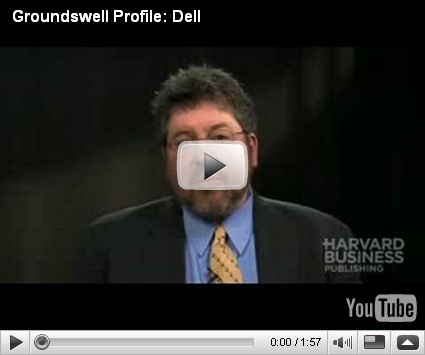
Feature Video: Dell: Answering Questions with Support Forums, Josh Bernoff

How one “critic” (using the Social Technographics Ladder) saved Dell $1M in support costs.

Feature Presentation: Augmenting your Technical Documentation with User-Generated Content, The Content Wrangler

Slides 18-21: Lesson 1-There’s no one best way to organization information
Slides 22-25: Lesson 2-Users don’t care where they get help from
Slides 26-27: Lesson 3-Users are not a homogeneous group of clones
Slides 28-33: Lesson 4-Users are talking about you right now!
Slides 34-39: Lesson 5-Consumers love video and increasingly expect it
Slides 40-44: Required reading

What I learned:
1)
People care, want to connect and help
For you hard nosed right brained people who think that “feelings” and “emotion” have nothing to do with business….think again! Hard nosed analytics and logic are still needed but the human side of business relationships are no different then personal ones. There are people who want to help solve problems because it makes them feel good. Emotions matter and creating a community that cares not only helps your customers it can impact your bottom line.

If your Social Technographic Profile over indexes in the area of joiners and critics and you have a complex product/solution then it is quite possible people are already helping each other out in forums, groups and on message boards. You should find this out and decide how you want to participate.


2) Your company needs to invest resources
First you need to determine whether people are supporting themselves through various social media tools and services. This takes patience, time and money. You need to dedicate a person or group of people to find this out.

Second, once you’ve decided how you want to help the groundswell you need to make sure the community grows and is active. It CANNOT be left alone to run on auto pilot. If someone asks a question they expect it to be answered. Figure out ways to make sure comments get answered within a reasonable timeframe.

Don’t think the technology and community will look after itself. If you want comments on each product page for example and you have 6000 products that means you could have 6000 different pages with questions on them. Think it through. Scale is not just about technology it's also about resources (people, time and money) and your ability to deliver.

3) Make it easy for top reviewers/answer providers to be found
These folks are amazing! Reward them by thanking them for their contributions. Get to know them as people and as potential employees. Make it so they can be found through search on your site.

4) It’s about solving problems, creating connections and institutional intelligence
Whether you use forums, wikis or reviews the purpose is to provide a mechanism that solves customer problems while reducing your support costs. In doing so you are creating direct connections with people who use your products and services.

People who will contribute answers and value add content which is now accessible to all people inside and outside of your organization. Tacit intelligence is what’s in our heads. The greatest fear companies have today is when their talent leaves so does the intelligence they’ve gathered that's in their heads.

Institutional intelligence is different. Forums, wikis and other tools generate intelligence which can be stored and searched. It becomes your company’s brain so to speak. Now when talent leave you have less to worry about.

Mar 9, 2009

B2B Marketing Integration Framework – The B2B “Marketing Mix” or 4 R’s of Marketing

UPDATE: My B2B Marketing Integration Framework evolves. For an updated version please check out this post. Thx.

A key ingredient of the Marketing Integration (MI) Framework is principles or what I call the 4 Rs of B2B markeitng.

I’ve used this marketing mix to help me filter and set priorities when it comes to key marketing strategies and tactics. Each “R” aligns with the B2B marketing gears referred to above.

B2B Marketing MIx, 4Rs, March2009

Relevance – What you say and what you offer must be relevant to the markets you serve. The information you share about the problems you solve needs to be understandable and relative to the current and unrealized business needs of your customers

Relationships – Developing and maintaining strong and meaningful relationships with key stakeholders is more important then ever before. Be relevant, build your reputation and leverage relationships to separate yourself from the competition. Communicate with the idea of building these relationships and creating a community

Reputation - Your reputation and your B2B brand is built on the back of your successes and what others say about you through formal reference programs, word of mouth and word of mouse (search results and social networks/media)

Return – focus on producing a return for your stakeholders and your company. Seek ways where every stakeholder will generate measureable returns. A customer may need publicity while you and your partner may need a case study. Figure out how to create win, win, win scenarios

Let’s apply this to a real world example.

You’re trying to figure out how to make the most of your marketing budget. The recession is making you think hard about where, when and how to spend funds.

You’re looking at the tradeshow budget and deciding which event to cut. Try asking these questions (just follow the circle above starting with relevance and then go clockwise):

1) How relevant is this event to customers, partners, prospects and the markets you serve? Is it the most important show of the year to your customers? If so, who attends and why? Do you have anything to say at this event that is compelling? Something that that will position you as in tune with what’s going on in this market?

2) What relationships will this event help create and develop? Will it help a customer? Will it help a partner? Can you strengthen relationships with the media, analysts and thought leaders? Will it damage any relationships if you don’t attend? If so, why?

3) How will you use this event to improve or build upon your reputation? Can you showcase a solution you implemented for/with a customer? Ideally a solution that is relevant and is a catalyst to strengthen relationships important to you and your customer?

4) What returns do you expect from participating in the event? Hard returns such as sales opportunities, feature articles, key account meetings and net new account discoveries. What returns can you provide to your customer? To your partners?

There is an art and science to B2B marketing. I hope that this mix is something that is helpful to you and your company. As always feedback is welcome and encouraged.

Mar 4, 2009

B2B Marketing Integration Framework – The B2B Marketing Gears

UPDATE: My B2B Marketing Integration Framework evolves. For an updated version please check out this post. Thx.

In my last post, I introduced my Marketing Integration (MI) framework. This framework has six planks that work together in order to align strategy with actions that produce results.

This framework has been developed (it continues to evolve) to help solve key problems that exist in B2B markets where there are long sales cycles, complex solutions & sophisticated buyers.

First of all, sales and marketing is not a dirty word!

With the exception of monopolies, every organization markets and sells something. Most B2B oriented companies have marketing and sales professionals whose job it is to generate results. They have to contact prospective buyers to inform, educate (sometimes annoy!) and encourage them to buy something. Reps need to meet with IT buyers and marketers need to promote “the latest and greatest”. In fact, it is highly probable that the IT buyer has a sales and marketing organization promoting his/her company’s products and services.

But, hang on…there’s a reason why a buyer doesn’t return a call or click on that link!

Now hold on a minute. IT buyers are being inundated with “cold calls” and reps that provide no value (or at least that’s what some have told me over the past couple of months). Heck, those reps just want “the deal” and to play golf. Actually, I happen to know quite a few really good Account Managers (Kimberly, Colin, Sean, Mark, Alex, Anthony, Scott, David…come to mind).

IT buyers tell me that manufacturers and “solution providers” send them to their websites for information (assuming the links still work) but over half the time they don’t get the content they want and need. In fact, they may have a bad taste in their mouths already. As homer would say “DOH”!

There is good news though!

There are extremely good account managers and marketing professionals that do work together to provide value and produce results for their customers and their companies. I’ve been blessed to work with forward thinking reps, open minded executives and great partners like Cisco who support an integrated approach to marketing and sales.

These talented people and progressive organizations have helped me develop my Marketing Integration (MI) framework. This framework has 6 planks. The first being the “B2B Marketing Gears”.

Marketing Integration (MI) Framework – B2B Marketing Gears

GTM Gears

These three gears make up the go to market focus areas for a B2B marketing plan.

Branding and Positioning – If you don’t think branding matters, when it comes to B2B organizations, I suggest you read Philip Kotler’s book B2B Brand Management. Today, you must clearly communicate what you stand for, what you offer and why it’s of value to your customers. The branding and positioning gear covers three things:

  • Identity – brand architecture, guidelines and corporate identity
  • Offering – solution mix and the addressable market(s) it serves
  • Research – feedback and information on/from customers, partners and competitors

Communications and Community – Marketing communications is changing in two primary ways. First, the content we create must be of value to recipients, available in various formats (text, graphics, audio and video) and in sync with the buying cycle. Second, you must allow for interaction and community development. My blook report on Groundswell covers this in detail. Communications must be engaging, educational and interactive with social media playing an increasingly important role. The Communications and Community gear covers three things:

  • Content – create meaningful content that sales enables, informs, educates and builds your brand reputation
  • Presence – use of the web, social media and sales support tools to advance brand positioning and generate demand for information, events and opportunities (sales, publicity and partner attention)
  • Following – create a community of fans (customers, prospects, partners, media and analysts) through multi-channel communications and automation and in real life briefings

Business Development – Business development is all about generating results. This gear covers three things:

  • Demand generation – execution of campaigns and sales promotions that generate, develop and nurture leads and build relationships
  • Customer/Partner development & engagement – create meaningful results oriented relationships with customers and channel partners
  • Sales enablement & advancement – empower the sales organization with programs, coaching and tools that will help them be successful.

These three gears work together but the first gear, branding and positioning, is what gets everything started. I hope this first plank of my MI framework is of interest to you and may help you be successful. Feedback and comments are encouraged.

Next post: The B2B “Marketing Mix” or 4 R’s of Marketing

Mar 2, 2009

B2B Marketing Integration Framework

UPDATE: My B2B Marketing Integration Framework evolves. For an updated version please check out this post. Thx.

I’m a big believer in using frameworks and systems when marketing a company. But not any framework or system. Only the ones that are built based on experience, that have evolved based on trial and error and work in the field (with customers and sales organizations for example). The ones that have flexibility built in them, are simple to understand and act as a bridge between strategy and execution.

Over the past seven years I’ve build such a framework which I call, you guessed it, my Marketing Integration Framework (MI Framework). I use it to help me stay focused, prioritize and set direction.

This framework is used to set direction, establish priorities and align strategy with tactics. The outcome is to establish brand preference and generate business results.

The 6 ingredients are mixed together as we integrate branding and business development in to your company. An illustration and brief description are below.

Framework

Figure: The MI6 Framework

Branding

  • Today's B2B buyers rely on word of mouth and awareness as their primary means of establishing a list of prospective service firms. The goal of marketing is to establish a unique value proposition and over time brand preference. The brand defines your value proposition, your "elevator speech" and what makes you unique.

Offering

  • Professional Services firms, especially I.T. Services and Solution providers (aka System Integrators), need to bring to market compelling services and solutions. The goal of marketing is to clearly define what that offering is, why it is of value and provide proof that this is the case. The offering is a core component of your brands value proposition.

Business Development

  • Professional services firms must constantly develop new business. Translation, they have to sell themselves. The goal of marketing is to create conversations with prospects and clients and position the brand, offering and value as something worth considering for purchase. Alignment and sales enablement is critical. Business development is what generates cash and profit for your business.

Principles

  • These are 4 simple guiding principles, called the "4 Rs of marketing", that you apply on a day to day basis that help set clarity in terms of direction and priority. The goal of marketing is use these principles to keep you heads clear and stay focused on what matters in B2B marketing...especially for professional services firms.

Programs

  • Building a brand, developing an offering and generating business requires a programmatic approach. The goal of marketing is to establish a strategy and put in place tactical programs to implement it. This needs to be done consistently and over time. Programs generate results, build your reputation and your brand.

Systems

  • Having in place repeatable systems make it easy to accelerate execution and measure progress. The goal of marketing is to establish systems that help companies learn, improve, measure and execute in the areas of branding, offer and business development. Systems make it possible to do good things again..faster.

Feb 25, 2009

Groundswell Blook Report:Chapter Seven-Energizing the groundswell

Groundswell is broken down into three parts. Part two (chapters 4-9) focus on tapping the groundswell. The authors provide advice and a strategic framework on how to do this.

Chapter 7: Energizing the groundswell

FriendFeed Room: Chapter Seven reference links and case studies from the book. Join the room and start a conversation.

Feature Video: Constant Contact: Creating B2B Communities, Josh Bernoff

Feature Presentation: Online Community Best Practices, Jeremiah K. Owyang


Slides 5-11: Start with an objective
Slides 12-20: Developing a plan
Slides 21-25: Getting your company ready
Slides 26-28: Staff you will need
Slides 29-31: How to pick a vendor
Slides 32-34: Kick-starting
Slides 35-41: Growing and maintaining
Slides 42-47: Widgets and Open Social
Slide 48: Recommendations

What I learned:
1) Word of mouth/mouse is critical when it comes to energizing your groundswell. If your customer base’s Social Technographics Profile over-indexes in the critics segment then you have a base of people who are high potential energizers. Remember, if you want to an energized base you’re going to have to let the chips fall where they may. So, if someone says your product sucks then swallow your pride and find out why IN THE community. Others may come to your rescue with other points of view. Reach out to people, especially the Jim Noble’s of the world who will provide you with authentic feedback and ideas. Hey, and they love to help and be heard.

2) Use energizing to help buyers reduce purchase risk and cognitive dissonance. eBags uses reviews as a way to get around a consumer not being able to touch and feel the bag in a retail store. This is essentially how eBay works in some respects.

3) B2B markets are fertile ground to establish a community and then as Captain Kirk would say “Energize” it. Why is that?

First, b2b buyers (especially those who evaluate and buy technology) have taken social media like a duck to water. They are using social media in their professional and personal lives.

Second, b2b buyers have a lot in common and they look for people who are in the same boat as they are. They need a place to bump into people who are and who have experienced the problems they are experiencing in their business. Online communities are a great place to bring these people with common interests together. If you’re a vendor selling stuff to these folks get involved but don’t be fake, don’t spam and don’t sell. Engage, encourage, listen, learn and figure out where and how to belong.

Third, if your a technology manufacturer or systems integrator, your buyers are looking for relevant content. The problem is that 58% of the time they can’t find it. Social media can help fill those gaps.

4) Whatever stage you are at in building your groundswell you must have commitment from the senior leaders in your company. They should take a long term view and realize that as you progress through the groundswell objectives (listening, talking, energizing, supporting and embracing) your potential risk increases as does the level of commitment. But, the potential reward does too!

Feb 11, 2009

Groundswell Blook Report:Chapter Six-Talking with the groundswell

Groundswell is broken down into three parts. Part two (chapters 4-9) focus on tapping the groundswell. The authors provide advice and a strategic framework on how to do this.

Chapter 6: Talking with the groundswell
FriendFeed Room: Chapter Six reference links and case studies from the book. Join the room and start a conversation.

Feature Video: How to have profitable conversations - blogging for business, yourBusinessChannel


0:20 Blogging creates conversations, creates credibility, content varies. Don't shout, don't tow the company line.
1:17 New to blogging? Learn from these "gurus". Lot's of good tips here. Don't shout. Tell a story and create conversations. Create content that is meaningful.
3:44 Importance engagement, being authentic and responsive.

What I learned:
1) The power of YouTube!
No experience in consumer marketing? No experience in producing television commercials? Neither did George Wright from Blendtec. When he saw how they tested their product by blending pieces of wood he knew that people had to see this! He thought, let's put the owner of the company in a lab coat and show him blending wood, dictionaries, iPhones, GPS devices etc. Let's make it a bit "campy" and throw it up on YouTube! Tom, the owner, embraced this idea! He didn't run from it. That's probably the most amazing part of this story. The leader got involved and embraced the idea.

2) Shouting vs. Talking
Broadcasting your message as loud as you can and to as many people as possible is shouting. Talking creates conversation. Conversations, at the least the good ones, are meaningful exchanges of information. You're not on a stage blurting out rhetoric. You're amongst a group of people engaging in dialogue. The key, is to create and share content through social media and participate in open and honest conversations.

3) Committment
If you want to engage in conversation through social media you must be committed for the long term. Your company must be committed to it. What does this mean? It means committing resources (people, money and time) permanently. It means culturally and strategically embracing social media as a channel to communicate, share and converse. And be open.

4) You may be surprised!

Be prepared to experiment and accept that as you begin talking and the groundswell begins to grow it will likely evolve into something you never expected. This is a good thing! Let it happen. Remain open, honest AND committed to making your social media experience rewarding for you and your customers.

Jan 24, 2009

Groundswell Blook Report:Chapter Five-Listening to the groundswell

Groundswell is broken down into three parts. Part two (chapters 4-9) focus on tapping the groundswell. The authors provide advice and a strategic framework on how to do this.

Chapter 5: Listening to the groundswell FriendFeed Room: Chapter Five reference links and case studies from the book. Join the room and start a conversation.

Feature Presentation: The Conversation-An Introduction to Social Media, Tactica Interactive Communications
Slides 1-16: Social media defined, some Canadian Demographics (these folks are from wintery Winnipeg)
Slides 17-28: Ten keys to Social Media Success
Slides 29-60: Social Media Tools and Do's and Don'ts for each (great content)
Slides 61-76: Social Media Myths
Slides 77-78: Three take away messages (not sure I agree with this them, do you?)
Slides 79-81: Useful resources and credits

Feature Video: Groundswell Business Objectives-Listening, Josh Beroff
More Groundswell videos here.


:14 What is listening in the Groundswell and how do you do this?
2:30 What Cancer Treatment Centers learned from patient community. Not something they expected to hear...family doctors matter when it comes to referrals.

What I learned:
1) This may sound repetitive, but know where there are potential and existing groundswells for your industry and company.
Don't rush into things until you've got a handle on where and how people are talking about your industry and your company. Determine what the Social Technographics Profile is for your product, company and industry (This is covered in Chapter Three of the book and here).

2) Listening is a new and maybe better way to conduct market research
This could be controversial! For those companies spending money on traditional market research (focus groups, qualitative and quantitative surveys and interviews, polls etc.) social media may be a viable alternative. For those small to medium sized businesses that conduct little to no research (there are many), social media can be a cost effective (no, not free) way to listen and learn from your market.

3) Listening is about insight and learning
Listening is not about collecting data! It is about gaining an in-depth understanding and knowledge about your market, your customers and whoever else chooses to use and talk (or not talk) about your brand. People may not be directly talking about you or your brand, but it is probable they are talking about things that are relevant to your market.

4) Listening is the first step to change
The group that champions listening and social media in your organization should be listened to and supported by the leaders (at the very least) within it. Take them seriously! This team of listeners will bring insight, ideas and recommendations that will likely influence strategic direction and decisions. If the leadership team is not prepared to listen and take this seriously then don't bother starting. Tell them to put their heads in the sand and pretend that everything will go away.


5) Monitoring and Communities are the two primary ways to listen
The social media demographics for your industry, geography and the age of your buyers will help determine where and how you should listen. Monitoring is one option where you use tools and/or services to collect and rank conversations that matter. Communities of special interest can help you understand and converse with key people with similar interests, problems and needs. This can be useful where there is some void or barrier for people to connect.


Jan 18, 2009

Groundswell Blook Report:Chapter Four-Strategies for tapping the groundswell

Groundswell is broken down into three parts. Part two (chapters 4-9) focus on tapping the groundswell. The authors provide advice and a strategic framework on how to do this.

Chapter 4: Strategies for tapping the groundswell
  • The POST method: people, objectives, strategy, technologies
  • The five objectives: listening, talking, energizing, supporting, embracing
FriendFeed Room: Chapter Four reference links and case studies from the book. Join the room and start a conversation.

Feature Presentation: Presentation on Groundswell POST Process, Barbara Nixon
Groundswell POST Process
View SlideShare presentation or Upload your own. (tags: li forrester)

Slide 2: Corporate adoption of Web 2.0 technologies, 2008
Slide 3: Web 2.0 Approach-Avoidance syndrome symptons
Slide 10: The POST framework or four step approach to the groundswell
Slide 12: Functional roles in your company and how they align with five groundswell objectives
Slides 13-23: Case studies
Slide 24: ROI of an Executive Blog
Slide 25: Keys to success

Feature Video: Groundswell Business Strategies, Josh Beroff
More Groundswell videos here.


:25 It is time for companies to get involved in the groundswell
:55 Four step approach to getting involved. Key is to do these steps in the right order. Don't start with technology.
2:00 Josh sounds a bit like a pirate (argh)
2:15 A long moment of silence. Not knowing objectives is a sign you're not ready
2:40 Five objectives. Josh covers the "Listening" objective with a real world case study about MD Anderson

What I learned:
1) Follow the four step planning process
Don't rush into things because your competition has started a blog, a Facebook fan page or a product ratings site. Follow the POST process and stay curious about what customers are ready to do online and what objectives you want to accomplish for your company. On page 67 the authors walk you through the POST process in detail providing you with key questions to ask yourself to help you shape your groundswell initiative.
2) Your Groundswell objectives must align with your corporate objectives
Review the five primary groundswell objectives currently being used by companies. Understand what each objective can do for your company and consider the following. You'll need executive sponsorhip and buyin from the key business leader(s) within the company. They'll need to see that the groundswell objective align with the broader company objectives and most likely its culture (mission and values). Create integration points with key business functional areas (sales, marketing, admin, operations etc) and processes.
3) Start small, do it fast, listen, learn and be prepared to adjust...but stay committed
Wow! Once objectives have been established try something that is simple, that can be measured and be patient. Be prepared to make mistakes, listen, learn and adjust. Remain committed to the groundswell process and recognize that it is hard to predict what will happen. Remain open minded and see where the groundswell will take you. Remain authentic, honest and involved in the groundswell.

Additional Articles that may be of interest:
Groundswell strategy and the social media, Businessworld Online (Dec 2008)
Latest Forrester Report Provides A POST Up Strategy For Firms To Tap Into Social Media (B2B focus), Demand Generation Report (Dec 2008)

Jan 12, 2009

Groundswell Blook Report:Chapter Three-The Social Technographics Profile

Groundswell is broken down into three parts. Part one (chapters 1-3) focuses on understanding the groundswell.
Chapter 3. The Social Technographics® Profile
  • Defines a data tool for analyzing social behavior of any group of customers
  • CASE: A community for alpha moms
  • Data and analysis for six examples: Gen Y, Japan/PC, politics, retail, seniors, health care
FriendFeed Room: Chapter Three reference links and case studies from the book. Join the room and start a conversation.

Feature Presentation: Social Technographics Explained, Josh Bernoff
Social Technographics Explained
View SlideShare presentation or Upload your own. (tags: social media)
Feature Video: Social Technologies-Your Customers Are Revolting, Charlene Li


1:10 - People move up and down the ladder and assume various roles in the Groundswell. They perform multiple roles depending on things like topic, interest and industry.
1:45 - Roles in the Groundswell: Creators, Critics, Collectors, Joiners, Spectators and Inactives.
3:25 - Why classifications?
3:50 - Case study: Alpha Moms. Using POST strategy to determine how best to engage with Alpha Moms. The key is to look to see where they over index. Target Critics, Collectors and Spectators.
7:15 - Embracing customers when they are revolting against your brand. What you can do. The "GM Insiders" example.
8:42 - Customers ignoring your messages. The GoDaddy example.

What I learned:
1) Know what your customers do online.
Find out how your customers are participating in the groundswell. Understand the roles they play in groundswell. Where are they on the Social Technographics ladder? What percentage are creators vs. critics? Joiners vs. spectators? Understand this because it tells you where to play in the groundswell.

2) Look for the "Over Index"
The Social Technographic Profile ladder consists of six different types of groups. Once you find out where your customers are (or aren't) playing in the groundswell focus on where the "swell" is in your market. This is done by looking for the groups that "over index". If more people in your market are joiners then the national average then focus on them... don't create a community where joiners can blog and upload content...because the won't.

3) The Groundswell is about human psychology & sociology
People want to connect with others who have similar problems, goals and ideas. They want to reach and relate with like minded people. Some want to lead, some want to help, some want to share and some want to watch.


Dec 29, 2008

Groundswell Blook Report: Chapter Two-Jujitsu and the technologies of the groundswell

Groundswell is broken down into three parts. Part one (chapters 1-3) focuses on understanding the groundswell. The authors ask and answer the questions why the groundswell and why now?

Chapter 2. Jujitsu and the technologies of the groundswell
  • Concentrating on the trend, not the technologies
  • Jujitsu: turn the groundswell to your advantage
  • Description of all social technologies with data on usage around the world
FriendFeed Room: Chapter Two reference links and case studies from the book. Join the room and start a conversation.

Feature Presentation: Marta Z. Kagen's presentation. Here's Marta's profile.


Reason #1: Social Media is Mainstream!
Slide 2 & 3: Social Media defined
Slides 7 to 16: Social media demographics and stats
Slides 17 to 24: Traditional marketing communications isn't working
Reason #2: Trust!
Slides 25 to 30: Trust comes from other consumers in the form of recommendations and dialogue
Reason #3: Brand Talk!
Slides 32 to 34: I'm not sold on these stats. Suffice to say, some brands are being blogged about.
Reason #4 & 5: More adoption/Future customers
Slides 36 to 44: Predicted adoption trends, demographics and buying power of digital natives
What to do?: Slides 45 on.

Top Five Things I learned:
1) Does this Groundswell thing fit with you and your company?
The first thing to think about is whether creating a groundswell is possible or not. There are many things to consider. First, how open is management to the idea of engaging online? Do they understand FULLY what this means? Second, do your customers engage in social media activities now and if so how would it make sense for them to engage with you? Third, can you provide something of meaningful value to your customers that also legitimately ties and relates to what you offer?

2) It takes knowledge, time, skills, experience and commitment.
If you're willing to take the plunge into the groundswell a company needs to realize that "getting into" social media is not a fringe project. It's a conscious decision to change the way you engage with customers, prospects and other stakeholders. The management team of your company need to become engaged themselves in social media (chances are that they are not). Leaders lead by example. They need to become knowledgeable, commit their time, build their own skills and experience social media. One way to do this is find a few 20 something employees and have them teach, mentor and potentially lead management in this area.

3) Start slow and focus first on listening and learning
Don't rush into this. Establish a listening and learning strategy first. Chances are that groundswells already exist or are developing somewhere in your industry and the industries that your customers serve. It could be that your best social media bet is in the industries that your customers are in and not your own. Be sure to invest time and effort focused on learning, listening and sharing. Don't run out and start a blog, a community or a Facebook Fan page tomorrow.

4) This is still very new - we are all learning and there are no experts
We are all new at this and we are learning as we go. We are making mistakes and taking risks. This creates uneasiness with companies that don't like uncertainty, need to justify cost and want to control the message and the brand. There is social media roadkill out there including: Walmart, Motrin & Pepsi. There are social media "successes" that are dubious at best. I thank these companies for taking these risks. They are learning opportunities for all of us.

5) Content, Community, Capacity!
There is an emerging theme I'm starting to notice as I study social media. Content is being created at an accelerated rate. Communities are being formed every minute. People are connecting through Twitter, Linkedin, Facebook etc. The information firehose is starting to gush! We now have inboxes for email, tweets and RSS feeds! There is now an abundent supply of information, access to people who want to help and share. What we now must do is think about how we can use the information, the people and the tools to be productive and deliver value.


Dec 21, 2008

Groundswell Blook Report: Chapter One-Why the Groundswell and why now?

Groundswell is broken down into three parts. Part one (chapters 1-3) focuses on understanding the groundswell. The authors ask and answer the questions why the groundswell and why now?

FriendFeed Room: Chapter One references links and case studies from the book. Join the room and start a conversation.

Feature Video: Rodney Rumford of FaceReviews, Interviews Charlene Li and Josh Bernoff (note: works in Firefox but not Internet Explorer)


Video Timeshift Timeline
o:39 Why read Groundswell?
1:04 The P.O.S.T framework for creating your Groundswell strategy
1:33 Where the name Groundswell came from
2:42 Eating their own dogfood. Online tools used to support book
4:17 "Hey CMOs and Brand Managers. Wake up you have no control!"
5:50 Are companies listening for and to the groundswell? One example: H&R Block using Twitter to listen
7:30 Execs need to do more then ask what social media and networks are. Get involved!
7:58 Final words of wisdom

Top Five Things I learned:
1) Online communities can be powerful and do create change. Leaders like Kevin Rose, who on May 1/07, bet the farm when faced with legal consequences by putting faith in his community of enthusiasts who felt that Digg (and by extension them) should not be censored by anyone. This "act of community" is just one of many that have and are taking place now. People will talk about your company, the message they deliver will be theirs and they will weigh in on your decisions. In some cases they will influence your decisions..sometimes they will change them!

2) Things are the same AND different. People depend and draw strength from each other. Strength is created in numbers. There is a need to create community but in the real world it is hard to find people with similar interests. The internet, with social media networks and services, is making it cheap and easy for people to find, create and support communities of common interests and causes. The natural need for humans to group and converse is being enabled by the social media and online networks. These online communities are now manifesting themselves into IRL (in real life) events such as "Meetups" and "Twitups".

3) Businesses can be built online using shoestring budgets. Guy Kawasaki's site Truemors cost under $13K to launch. If this is not a positive sign given the recession I don't know what is! Online entrepreneurs can launch businesses fast and economically. Whether you are an independent professional or General Motors take heed and learn how to be this way!

4) The two most unlikely things are happening in the blogosphere! Many, but not all, big companies are ignoring or afraid of social media. Many, but not all, "older folks" just don't get blogging and all that "web 2.0" stuff. Bob Lutz the vice chairman of GM started blogging, in 2005, to establish a human side to GM. Bob is in his seventies! Big business is blogging and us older folks are leading the charge along with the younger folks like Kevin Rose. In fact GM is using their blog to engage with car enthusiasts and from time to time will use it to address erroneous and inaccurate statements made by automobile journalists.

5) Groundswells are or will be created around you. The book defines a groundswell as:

A social trend in which people use technologies to get the things they need from
each other, rather than from institutions like corporations.
The smart companies will embrace this phenomena because people will be sharing stories about their brand whether they be positive or negative. Learn with your customers and from the community.

Local Twitter List experiment

Social networking isn't restricted to the internet. We all want to socialize but there are barriers preventing us from social networking offline especially with people we don't know. Twitter has got to be the most prevalent social networking tool (today).

The problem I have with Twitter is not really knowing much about the people I follow and who follow me. I trying to remedy this by creating "Listening Posts" and now "Twitter Locals Lists". This list is meant to segment Twitterati based on geography. In a way help you establish a local network of people with similar interests who may want to get together, work together etc.

I'm using a simple form I created using Google Docs and anyone can view the lists. In fact, you can fill out the form below. Here is the list for you to look at.

Dec 20, 2008

Blook Report: Groundswell

Over the next few months (may be longer, I'm doing this in my spare time) I'm going to be producing an in-depth blog report on the book "Groundswell" researched and written by Charlene Li and Josh Bernoff.

The book is broken into three parts:

Part 1: Understanding the Groundswell
Part 2: Tapping the Groundswell
Part 3: The Groundswell Transforms

Here is the table of contents.

I'm an avid reader of business books and love to learn. I read so many books, blogs, magazines and now tweets; I sometimes wonder how much I actually remember and retain! Having access to so much information is a good problem to have. We can now become subject matter experts because there is no shortage of content and people wanting to help educate you.

Yet, the problem remains the same. How can I retain and remember the many things I read each day? When I read "the" business book of the year, how will I remember what I read; let alone apply it to my business?

These questions led me to come up with the idea of producing what I call a "blook report". My goal is to use social media to the extent possible to add life to the text you read in the book. You'll need to buy the book in order to follow along (I'm not being paid to do this blook report or say this).

So what does a blook report include? At this point I focus on three things:
  • First, providing a summary blog post for each chapter on the key points that I think are important. I may relate them to personal experiences also
  • Each blog post will have a featured picture, video and links that lift the words off of the text to help build context and meaning behind the key concepts being covered in the chapter
  • and finally, there will be a series of supportive links located in a Friendfeed room where the the authors have made reference to real world examples, case studies etc
So why am I doing this? First, I am avid learner and will use this blook report as a reference tool when helping companies with their b2b programs. Second, it may help you do the same thing for your clients or your company. Third, it's a social media/groundswell experiment.

Stay tuned to this post for updates.

PART ONE: Understanding the Groundswell
Chapter One: Why the groundswell and why now?
Chapter Two: Jujitsu and the technologies of groundswell
Chapter Three: The social technographics profile

PART TWO: Tapping the groundswell
Chapter Four: Strategies for tapping the groundswell
Chapter Five: Listening to the groundswell
Chapter Six: Talking with the groundswell
Chapter Seven: Energizing the groundswell
Chapter Eight: Helping the groundswell support itself
Chapter Nine: Embracing the groundswell

Dec 16, 2008

Group Tweet Feeds or Listening Posts

In a previous post I introduced as a new feature my CxO Group Tweet Feeds. This has grown into a series of RSS feed lists which I call "Listening Posts". Below is my list. Enjoy. As always feedback is welcome and encouraged.

Tweeting Brands
Tweeting CEOs
Tweeting CTOs/CIOs
Tweeting CMOs
Tweeting COOs

I may consolidate the CxO tweets into one uber RSS feed. Thoughts? Does an aggregate feed work for you? I'm still thinking on it myself!

Dec 7, 2008

Looking for that Next Billion Dollar Idea - ProductCampToronto

Congratulation to Anna Gossen and her team for winning the Cisco I-Prize contest.


My team's idea, the HAN (Home Area Network - ya not that original! But it's what's inside that counts =)) was also a finalist. I led a session at ProductCampToronto about my I-Prize experience entitled "Looking for that Next Billion Dollar Idea". This wiki post gives you an overview of what the experience was like and includes some videos that may be of interest. Do you think there is a need for idea and innovation contests?

Nov 18, 2008

Getting "Ink" for your customers

In an earlier post entitled The Importance of Strategic References I talked about how I worked with the Michener Institute, while at Unis Lumin, to generate awareness for their digital slide technology. The direct result was a cover story in Technology for Doctors magazine. This print publication reaches over 10,000 primary care physicians and specialists across Canada.

Michener was thrilled with the publicity they received. We provided them with reprints of the article to use to their advantage. They have and continue to leverage this publicity to raise awareness and funding for new initiatives. There are some who won't see the immediate payback for Unis Lumin but my philosophy is that we partnered with Michener to help them showcase a solution that was made possible in part by Unis Lumin. This was one of my favourite experiences during my 7 years at Unis Lumin.

If you'd like to listen to the case study here's a podcast I had produced by Donna Papacosta from Trafalagar Communications.

Nov 6, 2008

ProductCampToronto1 Mindmap

I put this online mindmap together as a bit of an experiment. One branch lists the folks who were involved in organizing PCT1 with links to their blogs/sites. Another branch has our sponsors and links to their sites. The remaining branches are the sessions that took place with are linked to the PCT1 wiki page. While the sessions went well, not many notes were taken on the wiki. There were not that many people with laptops so this is understandable.

I'm hopeful that over the next little while PCT1 participants and the session leads will add their thoughts and ideas to these wiki pages so the PCT1 experience can continue.


Oct 4, 2008

Less then 1 month till ProductCamp!

PCT, big banner

We're less then a month away from Canada's first ProductCamp!We're excited and hopeful that we will have a great turn out on November 2nd.

Here's a quick update:

  • We are firming up sponsors and it looks like we're going to be able to offer a free T-shirt to participants. Here's the current list of sponsors with more coming on soon.
  • This weekend we hope to have the preliminary "Open Grid" posted so you can get a feel for what's planned first thing when you arrive. It will explain how the day will unfold.
  • I'd like for you to visit this page that outlines our goals for this event and to read our "cause". If you think it sucks feel free to change it/make it better. That's what this is all about...community creating and making change
  • And finally, please ensure you now formally register as a participant so we know who's going to show up....we need this because we want everyone to be fed, have a shirt etc. Please register here.. our goal is to have 100 people attend this event!

Remember this event belongs to us all. An event that creates and brings together a community of people interested in the product management profession. Those that want to better their skills, social networks and careers. I think it will also create new friendships and professional relationships. Let us know what you want to get out of PCT.